Blog posts filed under IEEE VIS

An Outsider’s Guide to the IEEE VIS Conference 2020

Want to watch a keynote by a Nobel laureate, catch the presentations of the best papers, or attend a workshop on visualization for communication? The IEEE VIS conference is taking place online in two weeks, October 25 to 30, and is free to attend this year. Here are a few starting points if you’ve never been to VIS and don't know why you should attend or what to watch.

IEEE VIS 2017: A SciVis Perspective

Since my (Robert)'s conference reports are almost entirely focused on InfoVis (and a bit of VAST), I have asked Noeska Smit, medical visualization professor and my collaborator in the Vis Potpourri postings, to write about VIS from the SciVis perspective. Everything below are Noeska's words.

IEEE VIS 2017: Best Papers and Other Awards

The IEEE VIS 2017 conference took place last week in Phoenix, AZ. I’m slower to write about it than in previous years, but to make up for that I’m not going in chronological order this time, but will break this report up in a more logical manner. This first part covers the opening, which included presentations of the best papers from all three tracks plus a new Test of Time award category.

IEEE VIS Pointers and Running

VIS is around the corner, taking place in Baltimore next week. Here are some pointers to a handful of interesting papers, as well as how to catch one of my live performances or attend the blogging and podcasting meetup – plus a reminder to bring your running shoes!

VIS 2015 – Friday

The final day of the conference was much shorter, only one full session and then the closing with the capstone. Here is a report on a few more papers, the capstone, a panel left over from Thursday, and a few random tidbits.

VIS 2015 – Thursday

Between the sessions, parties, discussions, running, and the occasional short sleep break, I fell a bit behind on the blogging about VIS 2015. After separate postings for Tuesday and Wednesday, this part covers Thursday. The posting about Friday will be short, but squeezing both days into one felt like a bit too much.

VIS 2015 – Wednesday

The second full day of VIS 2015 brought lots of papers on applications and design studies, and also a panel on solved problems in visualization. As on the first day, I have some observations and thoughts.

VIS Running Club 2015

I will organize runs again at IEEE VIS in Chicago two weeks from now. As with previous years, organization will be minimal: just show up ready to run. I will prepare routes in the 3-6mi (5-10km) range.

VIS 2014 – Friday

Wow, that was fast! VIS 2014 is already over. This year’s last day was shorter than in previous years, with just one morning session and then the closing session with the capstone talk.

VIS 2014 – Thursday

Thursday was the penultimate day of VIS 2014. I ended up only going to InfoVis sessions, and unfortunately missed a panel I had been planning to see. The papers were a bit more mixed, but there were agains some really good ones.

VIS 2014 – Tuesday

The big opening day of the conference, Tuesday, brought us a keynote, talks, and panels. Also, a new trend I really like: many talks end with the URL of a webpage that contains a brief summary of the paper, the PDF, and often even a link to the source code of the tool they developed.

VIS 2014 – Monday

IEEE VIS 2014 technically began on Saturday, with the first full day open to all attendees being Sunday. Monday continued the workshops and tutorials, and that is where we join our intrepid reporter.

The VIS Sports Authority

When you think of a conference, does sitting around a lot come to mind? Lots of food? Bad coffee? No time to work out? For the first time in VIS history, there will be a way to exercise your body, not just your mind. The VIS Sports Authority, which is totally an official thing that I didn’t just make up, will kick your ass at VIS 2014.
VisWeek 2012 Digest, Part 2

In this second installment, I pick some of the more noteworthy papers and events from Wednesday, Thursday, and Friday at VisWeek 2012. There was some remarkable work, which I think and hope will shape the future of visualization research.

VisWeek 2012 Digest, Part 1

I gorged myself on talks, panels, and tutorials last week. And parties, oh the parties. Time to digest all of it and, um, extract the most important bits. Since there is so much to talk about, I have split this up into three parts. Parts 1 and 2 will discuss individual papers and events, part 3 will add some more general observations.

A Few VisWeek Pointers

What good is a blog if it doesn’t serve the noble goal of self-promotion? Here are a few pointers to papers I’m involved in at VisWeek, as well a job posting that’s kind of my fault.

A VisWeek Survival Guide, Part 2

Less than two weeks to go until VisWeek 2012, so it’s time for the crucial second part of the survival guide. There are tons of things to see and do in Seattle, it’s easy to get distracted.

A VisWeek Survival Guide, Part 1

VisWeek 2012 will be held October 14 to 19 in Seattle, WA. The conference keeps growing, and this year is adding a new industry track. If you consider going, you should register by Friday to get the early registration discount.

Visualization is Growing Up

Several topics at this year's VisWeek conference have come up because visualization is playing a bigger role in important decisions. When the consequences can be severe, it is important to know whether a visualization actually works, whether we can trust it, and what biases it might present.

Blogging BOF at VisWeek 2011

Enrico Bertini and I are organizing a birds-of-a-feather meeting on blogging. Due to some miscommunication, this has turned into two venues, one being the BOF, the other a dinner or drinks or a dinner with drinks or something. Anyway, if you're going to VisWeek, you should definitely attend.

Paper: Privacy-Preserving Visualization

The point of visualization is usually to reveal as much of the structure of a dataset as possible. But what if the data is sensitive or proprietary, and the person doing the analysis is not supposed to be able to know everything about it? In a paper to be presented next week at InfoVis, my Ph.D. student Aritra Dasgupta and I describe the issues involved in privacy-preserving visualization, and propose a variation of parallel coordinates that controls the amount of information shown to the user.

VisWeek Bingo, Interactive Edition 2011

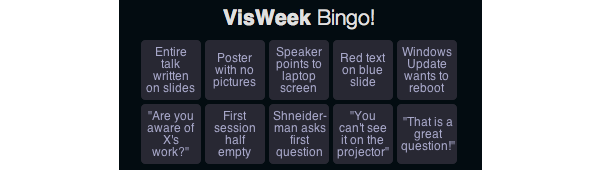
Last year's VisWeek Bingo was a big success, but it was also conceived of and created in such a rush that I'm embarrassed to even link to it now. For this year, I have created an interactive version of it for your perusal and amusement. It uses code Steve Streza developed for his Apple Keynote Bingo.

Blogging BOF at VisWeek

Enrico Bertini and I will host a Birds-of-a-Feather meeting Thursday night on Blogging in Visualization. We will talk about our experiences, answer questions, and hopefully dispel some myths about blogging in science. Whether you're going or not, I recommend reading the article You Aren’t Blogging Yet?!? in The Scientist.

The Theory Guide to VisWeek 2010

Theory is a big topic at VisWeek this year. You can get through almost the entire conference purely on theory papers. Whether that's a good idea is another question of course, but here's a guide how to do it.

Pargnostics: Screen-Space Metrics for Parallel Coordinates

Parallel coordinates are a very popular visualization technique for multi-dimensional numerical data. In this paper, we propose a set of metrics to better understand the types of visual structures users commonly look for using this technique. Based on the metrics, we can optimize the display to make it more readable, and allow the user to select dimensions based on their visual structures, rather than their existing ideas about the data.

VisWeek Preview: InfoVis Theory Workshop and Panel

This year's VisWeek conference has a distinct theory scent. It starts with the workshop, The Role of Theory in Information Visualization on Monday, and ends with a panel on theory on Friday. There is also a related BOF and a paper session at Vis.

InfoVis Theory Workshop Deadline Extended

We have received a few good submissions for the InfoVis Theory Workshop at VisWeek, but we're looking for some more. We are therefore opening submissions again, with a new, final deadline: September 13, 2010. If you couldn't make the first deadline, this is your chance.

Various VisWeek Workshops

I want to call your attention to three interesting workshops that will be held at VisWeek 2010 in October in Salt Lake City. One is on storytelling in visualization, another on visual analytics in healthcare, and a third one on theory in infovis. The deadlines for two of them are coming up soon.

Workshop: The Role of Theory in Information Visualization

Information visualization is a very applied field that prides itself on its practical applications and real-world scenarios. Ignoring the theoretical side is dangerous, however, because it limits our ability to distill useful information about the foundations of the field from the practical work being done, and limits our understanding of how and why our own creations work. The goal of this workshop at VisWeek 2010 is to bring together researchers interested in the theoretical aspects of visualization, define the field, discuss ideas and approaches, and get the word out about the importance of theoretical research in information visualization.

InfoVis Discovery Exhibition 2010

Showing the impact of visualization work is not something we as a community are particularly good at. The Discovery Exhibition at the Information Visualization conferences is a great venue for doing just that. If you have a tool that's used by real users for real work, submit a brief description by July 19.

VisWeek Preview: Changing the World with Visualization (Panel)

What good is visualization if it can't save the world? Or maybe at least change it. Make it a little better. Make a difference. I am organizing a panel at InfoVis next week to discuss what visualization already does, and what else we can do to free visualization from the confines of the ivory tower and have an impact in the real world. Three remarkable people will present their views and discuss with the audience.

VisWeek Preview: Live Coverage

Like last year, I will be live-blogging and tweeting from VisWeek. Here is some information on my plans and links to what others will be doing (that I know of). Feel free to add your links, Twitter handles, etc. in the comments.

VisWeek Preview: Visualization on the Web Workshop

The workshop Putting Visualization on the Web will be held on Sunday, October 11, from 2pm to 5:30pm at VisWeek 2009. If you are there on Sunday, please join us for discussions on everything related to visualization, blogging, web-based visualization, and a whole lot more. You do not have to register for the workshop separately, and you are welcome whether you submitted a position paper or not.

InfoVis 2009 Discovery Exhibition

After the underwhelming participation in last year's InfoVis contest, there will be a different approach this year: The InfoVis Discovery Exhibition. The goal is to collect reports of visualization is used in real-world scenarios, and how visualization tools can help solve real problems. There are already two examples, and with enough participation, this should turn into a great resource. See below for how you can participate, and what's in it for you.

Design Tutorials for VisWeek 2009

As one of the Tutorials Chairs at this year's VisWeek (which is the combination of the IEEE Vis and InfoVis conferences, and the VAST symposium), I want to make you aware of the upcoming deadline for submitting tutorial proposals: April 28. We are looking for a wide variety of ideas, but I want to especially encourage the submission of tutorials on design for visualization. VisWeek will take place October 10–16 in Atlantic City, NJ.

VisWeek 2008 Live-Microblog Archive

During VisWeek 2008, I wrote short updates on my website, which I called glimpses (a little pun on tweet). This is an archive of all of those, in reverse chronological order. In my transition to WordPress, I had to get rid of the comments, unfortunately. There were only a small number of those attached to these postings, though.

Live-Microblog from VisWeek (InfoVis/VAST/Vis) 2008

As promised earlier, I will be live-blogging VisWeek 2008, which will take place next week in Columbus, OH. I will mostly attend InfoVis and VAST, with the odd Vis session and workshop thrown in. The live-blog will appear in a box at the top of the frontpage, and there will be a separate RSS feed for these posts. Coverage should start Sunday (October 19) morning, and there will also be pictures.

The Sad State of the InfoVis Contest

In some fields, contests drive research and the entire field forward. Those contests are prestigious, and people list the fact that they won the contest in their CVs. In InfoVis, the contest is trying to appeal to researchers, but is getting little attention. What should the role of the contest be? And how can we make it more interesting?

InfoVis 2007: InfoVis for the Masses

The InfoVis conference this year had a theme that was not planned, but that made it even more impressive. That theme was InfoVis for the Masses, or Visualization for the People, and it was present throughout the keynote, many paper presentations, the panel, the World Visualization Day BOF, and the capstone. This is the beginning of a new era in visualization, and it is exciting to watch it happen.

InfoVis Panel: The Impact of Social Data Visualization

Visualization for the masses is a powerful means of communication, in an age where we have access to incredible amounts of data, but still little understanding based of what it all means. I have argued that visualization sets information free, I have criticized Swivel and Many-Eyes, and I have argued for reassessing who our users are. At Vis/InfoVis, I am organizing a panel with people from Many-Eyes, Swivel, and Gapminder.

InfoVis Contest 2007 Data

Like in the last few years, the InfoVis Conference 2007 is holding a data visualization contest. While the data is available late this year, we hope that by providing it in a very accessible format (XML), and also supplying program code to get you started (at least if you're using Java), we will attract more submissions. The focus is also more on the design than the data analysis this year, and the questions are much more open-ended (in fact, you can make up your own!).