Encoding vs. decoding
Visualization techniques encode data into visual shapes and colors. We assume that what the user of a visualization does is decode those values, but things aren’t that simple.

Visualization techniques encode data into visual shapes and colors. We assume that what the user of a visualization does is decode those values, but things aren’t that simple.
The Café Wall Illusion makes you to see perfectly parallel lines as being at an angle. It's a curiosity and a cool perceptual illusion – except when it shows up in a bar chart, as it did in this example.
We've turned the understanding of charts into formulas instead of encouraging people to think and ask questions. That doesn't produce better charts, it just gives people ways of feeling superior by parroting something about chart junk or 3D being bad. There is little to no research to back these things up.
A paper on a specific cognitive mechanism may seems like an odd choice as the first paper in this series, but it is the one that sparked the idea for it. It is also the one that has its 30th birthday this year, having been published in August 1985. And it is an important paper, and could play an even bigger role in visualization if properly understood and used.
Inattentional and change blindness are two fascinating phenomena that more people should be aware of. The Invisible Gorilla describes them as well as some other interesting and surprising psychological research.
While color is a purely visual phenomenon, the way we see color is not only a matter of our visual systems. It is well known that we are faster in telling colors apart that have different names, but do the names determine the colors or the colors the names? Recent work shows that language has a stronger influence than previously thought.
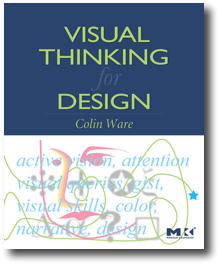
Colin Ware's latest book Visual Thinking for Design has a promising subtitle: active vision, attention, visual queries, gist, visual skills, color, narrative, design. That's covering quite a bit of ground, and also a lot of things not usually considered in visualization. While this is a book about design, I was interested in what it could teach people in InfoVis, and I review it from that point of view.