Blog posts filed under Application

Tracking 19,000 Runners Over 1,000km Across Virtual Tennessee

How do you show large numbers of people without losing track of the outliers? How do you keep a chart useful when the maximum values are orders of magnitude higher than the common ones? In an animated visualization I've built of the progress of over 19,000 runners across a virtual 1000km (635mi) race over 123 days, I've tried to solve some of these issues.

New, Improved Traveling Presidential Candidate Map

Many years ago, when this website was still young, I created a map of all the ZIP codes in the U.S. in numeric order and then wondered about the shortest path through all of them. I dubbed that The Traveling Presidential Candidate Map. Here is an improved version that's interactive and much more efficient than the old one.

A Look At Climate Data

Wether you believe that global warming is real or not, a bit of validation of the source data is still interesting. This is my second look at the global temperature data recently released by the UK's Met Office, this time using Tableau. There are some interesting data issues here, and a rather analytical visualization.

AppStore Billion Apps Live Visualization

Apple's AppStore for iPhone and iPod touch is about to sell its billionth application. You can watch Apple's pretty counter webpage, or you can see the downloads piling up and the rate of downloads visualized below. Unlike the billionth song download a few years ago, this is in (almost) real-time. The collected data and the Python script that generates the images using Google Charts is included.

A Fisheye Calendar at Yahoo!

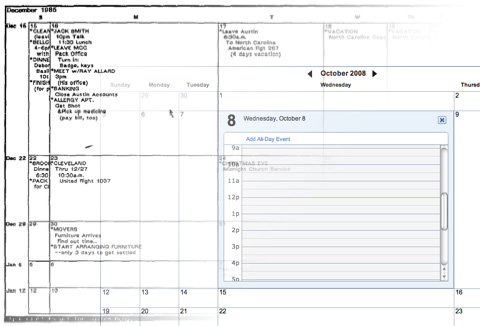
What a difference 22 years make! In 1986, George Furnas published his paper, Generalized Fisheye Views, which described what was to become one of the first (and most prominent) focus+context techniques. One of the examples he used was a calendar that showed the current day in most detail, with less space for the surrounding ones. Yahoo! just started an opt-in beta of their new calendar that uses the same idea.

Presidential Demographics, Part II

Would McCain be the oldest US President? Would Obama be the youngest? Who was the youngest president? Were presidents younger in the past or older? What is the highest number of years a former president lived after leaving office? Who served the longest? Whose term was the shortest? The interactive visualization below lets you answer these and a few other questions.

Expressive Visualization, Updated Presidents Chart

I used the Presidential Demographics chart in my talk at the Impact of Social Data Visualization panel at InfoVis 2007, and got some interesting responses to that. There is some interest in printing this out, so I have made a new version of the chart that is now also available as a PDF. Stephen Few used Joseph Berk's term "interocular traumatic impact" – a visualization that hits you between the eyes – to describe it. And this is exactly what visualization can do extremely effectively: visual communication, and not just of data.

Presidential Demographics

With Hillary Clinton and Barack Obama being likely Democratic candidates for the 2008 presidential elections, it is time to look at the demographics of US Presidents over the years. The following diagrams compare their sex, race, and faith with the whole population in 2001.

The Travelling Presidential Candidate Map

While working on the ZIPScribble map, I started to wonder how to untangle the beautifully scribbly lines, and finding the shortest path through all ZIP codes. In computer science, this is called the Travelling Salesman Problem (TSP), and so I decided to make this the Travelling Presidential Candidate Map.

iTunes (Music) Store Billion Downloads Visualization

On February 23rd, 2006, Apple's iTunes Music Store (iTMS, now called the iTunes Store) sold its one billionth song. In the days leading up that event, Apple had a countdown on its webpages, which provided interesting information about the download habits of its customers. This page provides a visualization of the collected data, as well as of data that others collected leading up to the 100 millionth and 500 millionth downloads.